
Understanding Trauma: Beyond the Event to the Internal Response
Trauma, a complex and deeply personal experience, significantly influences our internal response to fear and stress. It’s important to understand, as noted by experts like Bessel van der Kolk and Gabor Maté, that trauma is not merely about the external events that occur to us. Rather, it’s about what happens inside us as a result of those experiences. This internal process, a unique and individual response, shapes our perception and reaction to the world around us.
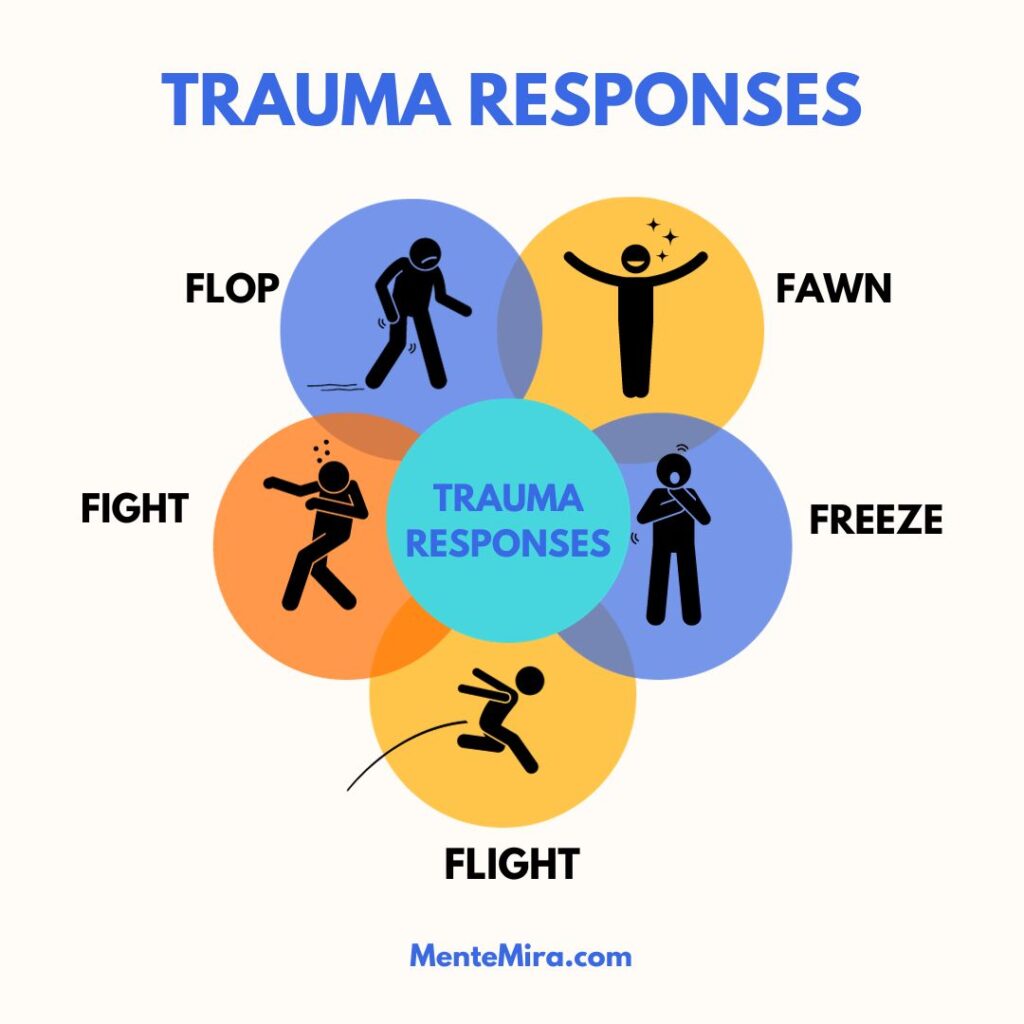
Historically, the ‘fight or flight’ response has been a foundational concept in understanding our body’s automatic reactions to perceived danger. This idea, initially conceptualized by Walter Cannon, and later expanded by others including Peter Levine, illustrates the instinctive ways our bodies and minds respond to threats. However, this framework has evolved to encompass a broader spectrum of instinctive reactions. These are collectively known as the 5 Fs of Trauma Response: Fight, Flight, Freeze, Fawn, and Flop.
Each of these responses represents a deeply ingrained survival mechanism, employed by our bodies and minds in the face of real or perceived threats. They are not choices, but rather automatic, biological reactions that occur in our nervous system. Understanding these responses is crucial in recognizing the profound and often lasting impact of traumatic experiences on an individual’s mental, emotional, and physical well-being.
Trauma compromises our ability to engage with others by replacing patterns of connection with patterns of protection – Deb Dana
The Role of the Autonomic Nervous System (ANS)
At the core of these trauma responses is the Autonomic Nervous System (ANS), a key component in how we respond to danger. When we encounter a threatening situation, the ANS is triggered, releasing hormones like adrenaline and cortisol. This activation prepares our bodies for immediate action, bypassing the more evolved parts of our brain responsible for planning and rational thinking. We essentially switch into a survival mode, with every aspect of our being primed to protect ourselves.
Real or Perceived Danger
These responses are not just limited to life-threatening situations; they can also be triggered by emotional threats or stress. For instance, a heated argument, a stressful work environment, or even an overcrowded space can elicit these survival mechanisms. This is particularly true for individuals who have experienced trauma, especially in their formative years. Their ANS may become conditioned to respond to certain cues or situations in ways that were once protective but may no longer be appropriate or helpful.
“We have learned that trauma is not just an event that took place sometime in the past; it is also the imprint left by that experience on mind, brain, and body. This imprint has ongoing consequences for how the human organism manages to survive in the present. Trauma results in a fundamental reorganization of the way mind and brain manage perceptions. It changes not only how we think and what we think about, but also our very capacity to think.”
― Bessel A. van der Kolk
A Legacy of Survival
The 5 Fs are not modern inventions; they are as old as humanity itself, serving as essential survival tools throughout our evolutionary history. These instinctual reactions are not a matter of choice but are automatic and deeply rooted in our biology, shared across the animal kingdom.
Exploring the 5 Fs of Trauma Response
- Fight Response: In the fight response, individuals confront danger directly. This can manifest as physical confrontation or verbal assertiveness. People in this state may display behaviours such as talking over others to assert dominance, often feeling a rush of adrenaline during conflicts. They might experience difficulty with emotional regulation and may perceive criticism or disagreement as threats.
- Flight Response: Flight is about escaping from a threatening situation. It often manifests as avoidance behaviour, such as immersing oneself in work to escape uncomfortable emotions like heartache. This response can also include physical behaviours like leaving a stressful situation. People in this mode are often busy and driven, possibly exhibiting symptoms of anxiety or panic attacks.
- Freeze Response: The freeze response involves a sort of mental and physical ‘shut down’ in the face of danger. In this state, individuals might become immobile or unable to take action, like procrastinating or feeling paralyzed in social situations. This response is common in scenarios like prolonged stress or burnout, where a person may disconnect from their surroundings, retreating into passive activities for comfort.
- Fawn Response: The fawn response involves a strategy of appeasement in the face of threat. This response is characterized by an excessive eagerness to please and placate others, often at the expense of one’s own needs and boundaries. It can manifest as people-pleasing behaviour, difficulty in saying no, or consistently prioritizing others’ desires over one’s own. Individuals with a fawn response might find themselves in codependent relationships, always seeking approval and validation from others.
- Flop Response: Flop is an extreme form of dissociation that occurs when an individual feels completely overwhelmed by a traumatic situation. It involves a psychological and physical ‘shutdown,’ where a person might become numb, disoriented, or even faint. This response is a protective mechanism, allowing a person to mentally and physically escape from an unbearable situation.
Therapy and the Five F Responses
Understanding and acknowledging one’s primary trauma response is an important step in healing. Therapy can provide a safe space to explore these responses and their origins, particularly in the context of past trauma. In therapy, individuals learn to recognize their automatic responses and develop healthier ways to cope with stress and triggers. The therapeutic relationship itself is key, offering an opportunity to experience connection, intimacy, and trust in a safe environment.
Reflective Questions to Consider
As you reflect on the 5 Fs of Trauma Response, consider the following questions:
- Recognizing Your Responses: Can you recognize these responses within yourself? When faced with stress or perceived danger, which of these reactions do you tend to fall into?
- Tendencies and Patterns: Do you notice a tendency to lean towards a particular response, such as fight, flight, freeze, fawn, or flop? How does this manifest in your daily life and relationships?
- Childhood Insights: Are there experiences from your childhood or past that may explain why you gravitate towards a certain trauma response? For example, if you grew up in an environment where conflict or abandonment was a concern, you might find that fawning – appeasing others to avoid conflict – is your instinctual response.
- Impact on Relationships: How do these responses impact your relationships and interactions with others? Do they hinder or help you in forming healthy connections?
- Coping Strategies: What coping strategies have you developed over time in response to these instinctual reactions? Are they helpful, or do they sometimes exacerbate stress or anxiety?
Reflecting on these questions can provide valuable insights into your trauma responses and how they influence your behaviour and relationships. Understanding these patterns is a crucial step in the journey of healing and growth.
Conclusion
The 5 Fs of Trauma Response offer a lens through which we can understand our instinctual reactions to fear and stress. By recognizing and exploring these patterns in ourselves, we can begin the process of healing and learning healthier ways to respond to life’s challenges. Remember, these responses are not flaws but survival strategies that have played a crucial role in our history. Understanding and working through them is the first step towards transformation and growth.
🌐 In-Depth Research on Trauma: For a deeper understanding of trauma, especially from an academic perspective, delve into Dr. Bessel van der Kolk’s scientific publications. His extensive research offers invaluable insights into how trauma affects the mind and body.
📚 Essential Reading on Trauma and Recovery: Expand your knowledge with these recommended books, each providing unique perspectives on trauma and healing:
- “The Body Keeps the Score” by Bessel van der Kolk: A pioneering work that explores the complex impact of trauma on individuals.
- “Waking the Tiger: Healing Trauma” by Peter Levine: A book that introduces innovative approaches to trauma treatment, emphasizing the body’s healing capabilities.
- “The Myth of Normal: Trauma, Illness & Healing in a Toxic Culture” by Gabor Maté: Dr. Maté explores the links between societal influences and individual trauma, offering insights into paths of healing.
- “The Body Remembers: Babette Rothschild”: focuses on the vital role of understanding the psychophysiology of trauma for both clinicians and their clients. It highlights how trauma impacts the body and introduces the concept of somatic memory, where traumatic events are implicitly stored in both the brain and body. This often manifests as symptoms commonly seen in posttraumatic stress disorder, such as nightmares, flashbacks, and dissociative behaviours, indicating the body’s refusal to be ignored.
🧘♀️ Understanding Relational Trauma: Relational trauma, one of the most prevalent forms of trauma, profoundly affects our ability to form healthy relationships. To understand more about how early relationships shape our adult interactions, consider enrolling in our free course on “Attachment Theory in Practice”. This course provides valuable insights into attachment styles and their impact on our relationships.
👥 Seeking Personalized Support? Our skilled therapists are equipped to support you in your journey of healing from trauma. Explore our team and find the right therapist for you here. Book a session directly through our website or have a 15-minute compatibility consultation with one of our therapists. Begin your journey toward healing and understanding by emailing us at [email protected].
📱 Stay Connected: For more insights and updates, follow us on Instagram @mentemira.psychotherapy.
These resources, along with personalized therapy, offer comprehensive support and knowledge, empowering you to understand and heal from trauma in its various forms, including relational trauma.